
Sex Offender Checks in Ohio County
The official starting point is the West Virginia State Police Sex Offender Registry. Select Ohio County when location matters, or search by a known last name. The registry is a distinct public-safety system. It is not a complete criminal history, a court docket, or a score of future risk. A result reflects duties imposed under state law and information reported to State Police.
Searchers should compare several identifiers before drawing a conclusion. Names can be shared, addresses can change, and the portal warns that some data may still await review or processing. When a profile seems wrong, use the registry correction channel rather than assuming the public display is final. For broader county records that are not registry listings, the Ohio County criminal history overview explains the separate court, custody, and agency channels.
Ohio County Registry Disclaimer Gate
The WVSP search opens behind a conditions-of-use gate. That first screen matters. It says the agency cannot guarantee perfect accuracy, does not assess a person's chance of reoffending, and permits reasonable safety precautions while barring threats, intimidation, and harassment. Accepting those terms leads to the search form; declining ends the session.
The official WVSP registry screen is shown in the captured view below. Its state ownership and disclaimer distinguish it from commercial people-finder pages, which should not be used for this task.
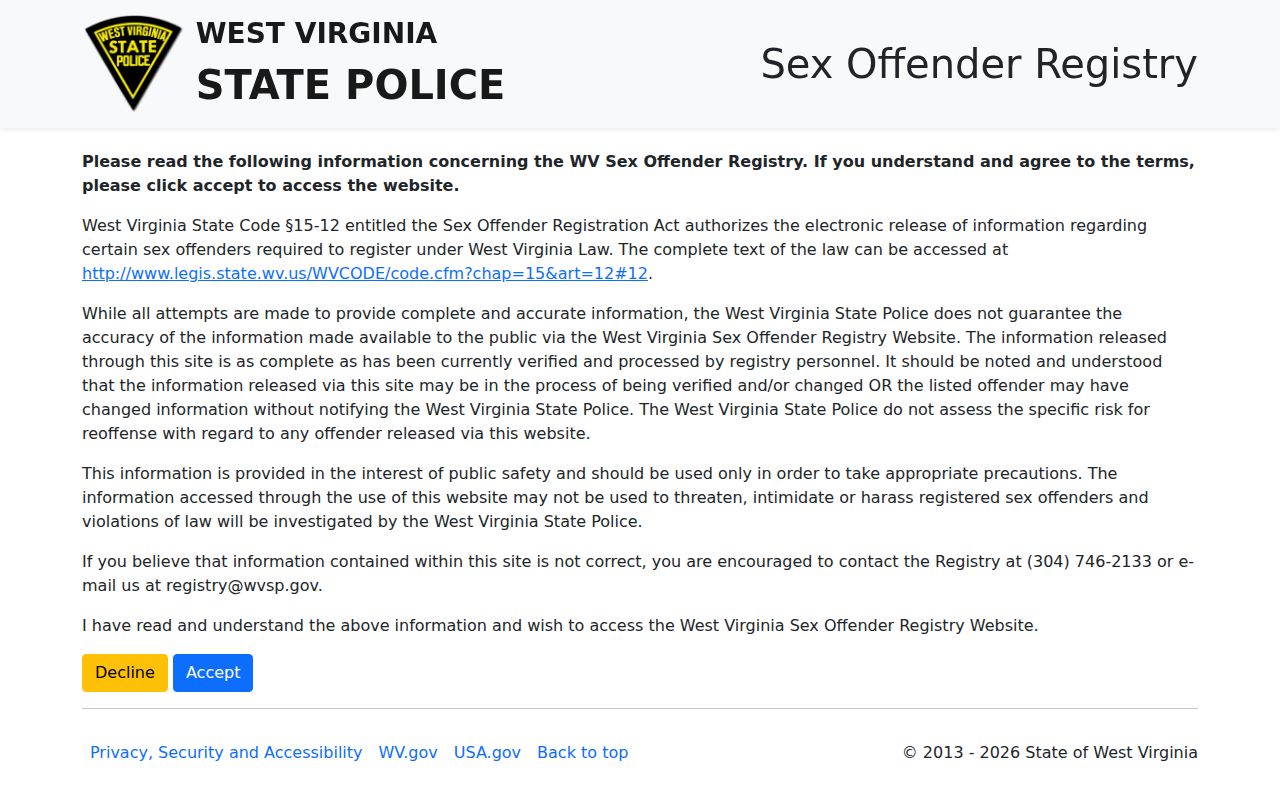
The gate sets the legal and practical frame before any Ohio County registry result appears.
How to Search the West Virginia State Police Sex Offender Registry
Prepare the clearest fact you know. A full street is useful for an address-based check, while a last name helps when the person's identity is known. The exact advanced characteristics could not be confirmed from an accepted live session, so they should not be guessed.
- Open the WVSP registry and read the disclaimer before accepting its conditions.
- Enter a last name or street name, or choose a city. Select Ohio for the county scope.
- Use only confirmed advanced filters shown in the live session, then submit the search.
- Compare the profile's photo, aliases, physical details, address, offense information, and status before treating it as a match.
The public form exposes these verified controls:
| Field label | Type | Required | Notes |
|---|---|---|---|
| Last Name | Text | Unspecified | Basic name search |
| Street Name | Text | Unspecified | Address-oriented search |
| City | Text or dropdown | Unspecified | Live control type was not reliably extracted |
| County | Dropdown | No | Select Ohio for Ohio County results |
| Advanced characteristics | Filters | No | Use only options shown in the accepted session |
| Disclaimer | Gate | Yes | Acceptance is required to search |
Ohio County Registration Is Not Tiered
West Virginia does not label public registrants as Tier I, Tier II, and Tier III. Its key public distinctions are an ordinary ten-year registration category, lifetime registration, and sexually violent predator status. These terms are not interchangeable. In particular, lifetime registration does not by itself mean that the person has been designated a sexually violent predator.
The controlling law appears in West Virginia Code Chapter 15, Article 12. The source image below points to the statute that defines registration and disclosure duties for Ohio County and the rest of the state.
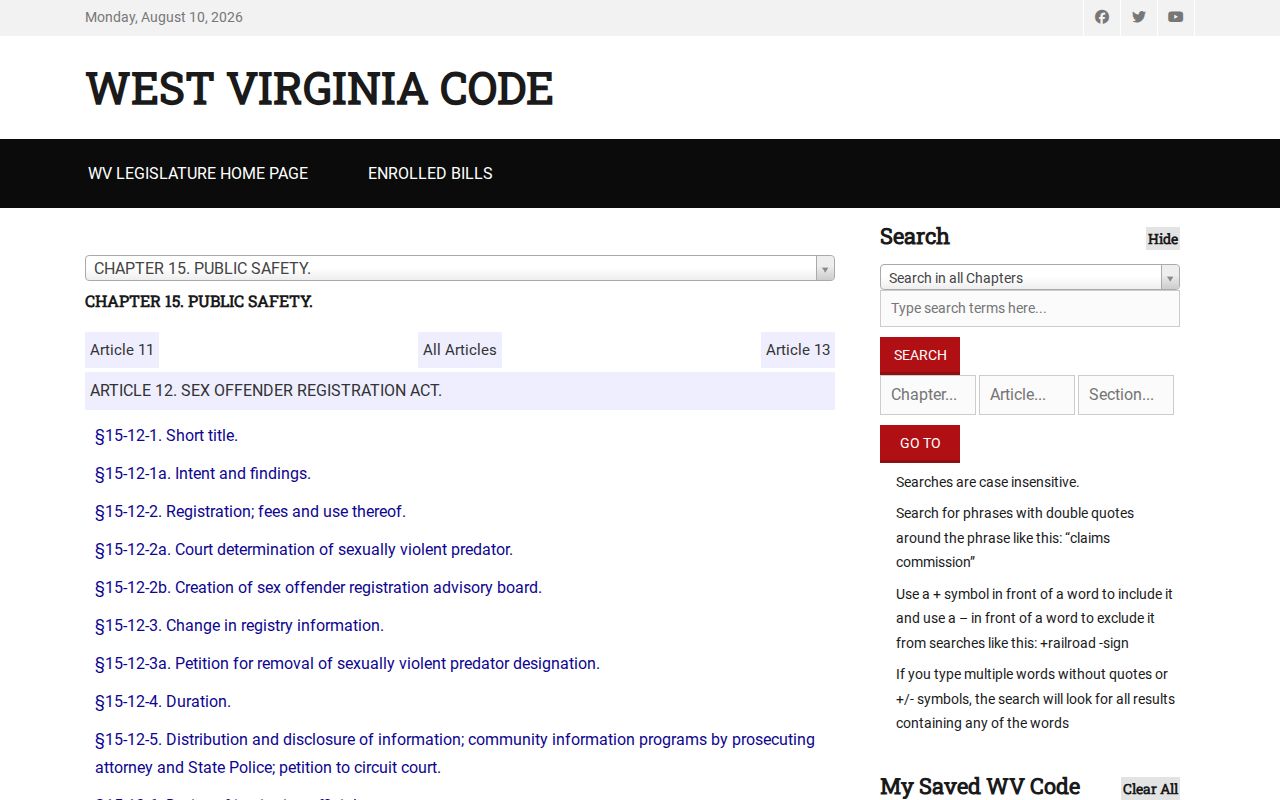
Reading the statute alongside a profile helps separate a registration category from an unsupported personal risk judgment.
Inside a Registry Profile
A public profile combines identifying details with the information state law authorizes WVSP to disclose. Intake records contain more than the public page. State Police may collect Social Security numbers, fingerprints, palm prints, identification documents, internet identifiers, phone numbers, license details, and drone identifiers, but that does not mean every item is published.
| Name and aliases | Reported names used to distinguish the registrant from people with similar names. |
|---|---|
| Photo and physical description | An image plus authorized identifying traits used to check a possible match. |
| Residence | The registered Ohio County address or other authorized residence information. |
| Offense information | Qualifying crime description and conviction information available for public disclosure. |
| Category and status | Registration category, compliance information, and related status shown by WVSP. |
| Other public facts | Authorized work or school geography and vehicle information when applicable. |
West Virginia Code §15-12-5 bars publication of a victim's identity and phone or pager numbers. A blank field should not be filled with inference.
Ohio County Profiles Are Not Risk Scores
The registry reports statutory facts. It does not calculate whether someone is likely to offend, and WVSP expressly disclaims that use. The distinction is vital when a reader sees a serious offense label, an old conviction, or a lifetime registration term. The page can support a safety plan, but it cannot replace current facts from law enforcement.
Appropriate steps include checking the correct identity, noting the date and status shown, and calling an official office when the information conflicts with direct knowledge. Do not repost a profile with added claims. Do not infer that everyone at a listed address is a registrant. Registry data concerns a named person and authorized facts, not a whole household.
Note: A registry listing is a statutory disclosure record, not proof of a new arrest, charge, or present danger.
West Virginia Registration Levels and Requirements
Duration and verification turn on the legal category. Registration generally begins at conviction unless the person is confined. After confinement, the deadline is generally within three business days of release, transfer, or a disposition change. Ordinary and lifetime registrants usually verify on an annual cycle. A sexually violent predator has a more frequent schedule.
| West Virginia category | Duration | Verification |
|---|---|---|
| Ordinary qualifying registrant | Ten years from release or placement on probation, parole, or supervision | Birth-month reporting and annual address verification |
| Lifetime registrant | Life for statutory repeat, multiple-victim, sexually violent, minor-victim, and related categories | Generally annual unless designated an SVP |
| Sexually violent predator | Life unless removed under the statute | Reports in January, April, July, and October, with address verification every 90 days |
The table describes reporting rules, not a three-tier public risk scale. Supervision conditions may add restrictions in a specific case.
The start date also matters when a reader compares profiles. For a person who is not confined, the duty generally starts at conviction. Confinement shifts the practical reporting point to release, transfer, or another qualifying change. The ten-year period is measured from release or placement on probation, parole, or supervision, not from the date a member of the public first sees the Ohio County profile. Only the agency and underlying court record can resolve a disputed calculation.
Ohio County Verification at Eoff Street
Ohio County registration and verification go to the WVSP Wheeling Detachment, not the sheriff. The detachment is at 2600 Eoff Street in Wheeling and can be reached at 304-238-1100. That office is the local point for required registration contacts. Registry data corrections are handled through the dedicated State Police staff at 304-746-2133 or registry@wvsp.gov.
Contact the correction line when an address, status, or other displayed field appears inaccurate. Give enough detail for staff to locate the profile, but do not send private identifying data through an unconfirmed channel. A discrepancy report is a request for agency review, not permission to alter or disregard the profile.
WVSP Wheeling Detachment
2600 Eoff Street
Wheeling, WV
304-238-1100
Cross-State Searches Near Ohio County
Ohio County sits in a tri-state region where a search limited to West Virginia can miss a person registered across a state line. The Dru Sjodin National Sex Offender Public Website provides the official federal cross-state layer. Use it when an address, commute, or known history reaches Pennsylvania or Ohio.
The national search view is captured below from the official NSOPW source.
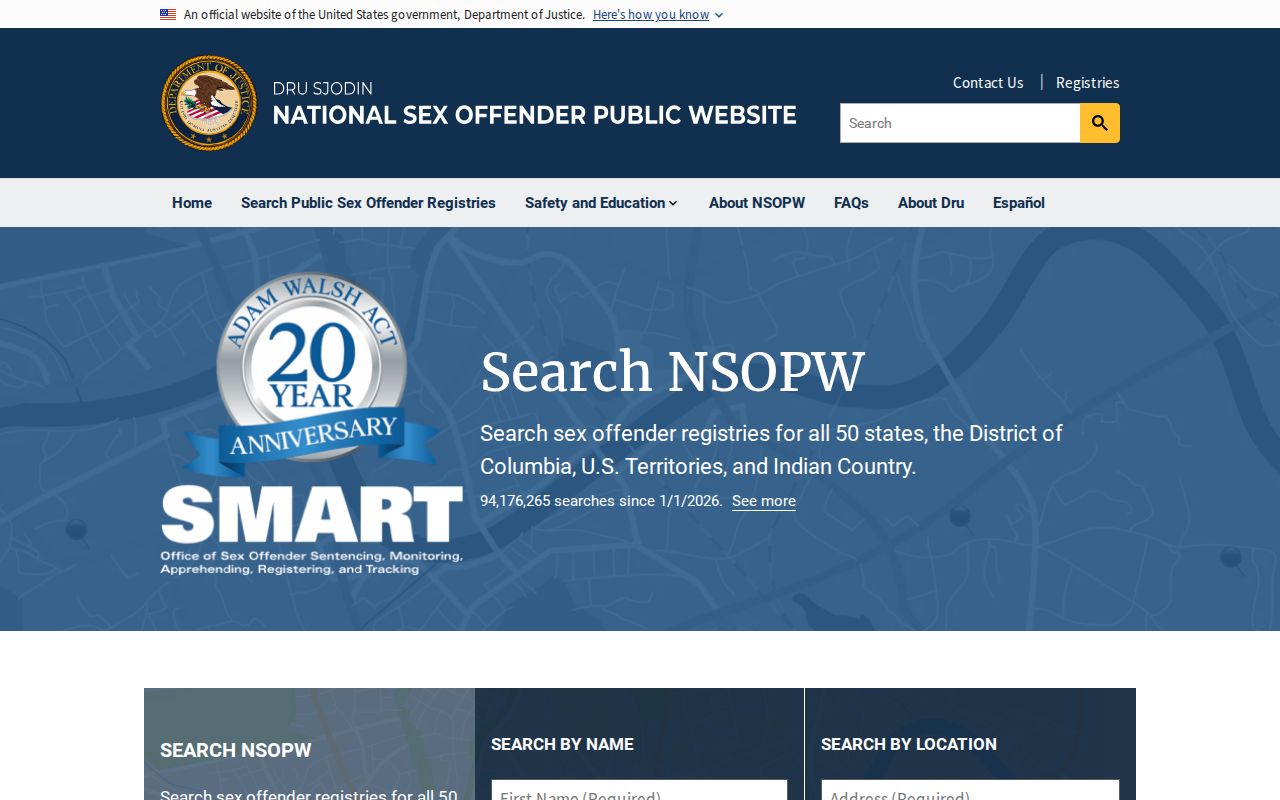
Return to the relevant state registry to verify the full profile because NSOPW aggregates participating public registries rather than replacing their official records.
No official radius-alert signup was found in the Ohio County research. Do not assume the portal will email neighborhood updates.
Ohio County Community Notification
Under §15-12-5, notice can flow to relevant law enforcement agencies, schools, child protective services, youth and day-care organizations, the FBI, and State Police posts. The Ohio County prosecutor and WVSP also have community procedures for sexually violent predators and some lifetime registrants. This statutory notice system is separate from a routine WVFOIA request.
That distinction explains why registry information may be public even though an agency cannot release a complete CIB record to any caller. Article 12 authorizes the registry's specific disclosures. It does not open every police, biometric, or investigative file.
Community recipients also have different roles. A school or youth organization may receive notice tied to its safety duties, while the public sees the fields authorized on the registry. Prosecutor and WVSP procedures apply to sexually violent predators and certain lifetime registrants. None of these routes turns the Ohio County listing into a general license to seek sealed court papers, victim information, or private intake identifiers.
Community Notification and Lawful Use
Use Ohio County registry information for awareness, careful identity checks, and reasonable safety planning. If current conduct suggests danger, contact law enforcement. If a registration fact looks wrong, contact registry staff. Neither path calls for personal confrontation or online accusations.
Use registry information lawfully: The WVSP conditions and West Virginia Code §15-12 bar using registry information to threaten, intimidate, or harass a registrant or household. Misuse can be a crime.
There is no blanket statewide 1,000-foot residency rule to apply to every profile. A person's supervision terms or another specific law may impose limits, but readers should not invent a distance rule from a map pin. The sound course is to verify the governing record with WVSP.